



About
Ingrid von Wantoch Rekowski /
Lucilia Caesar - Performing Arts Laboratory
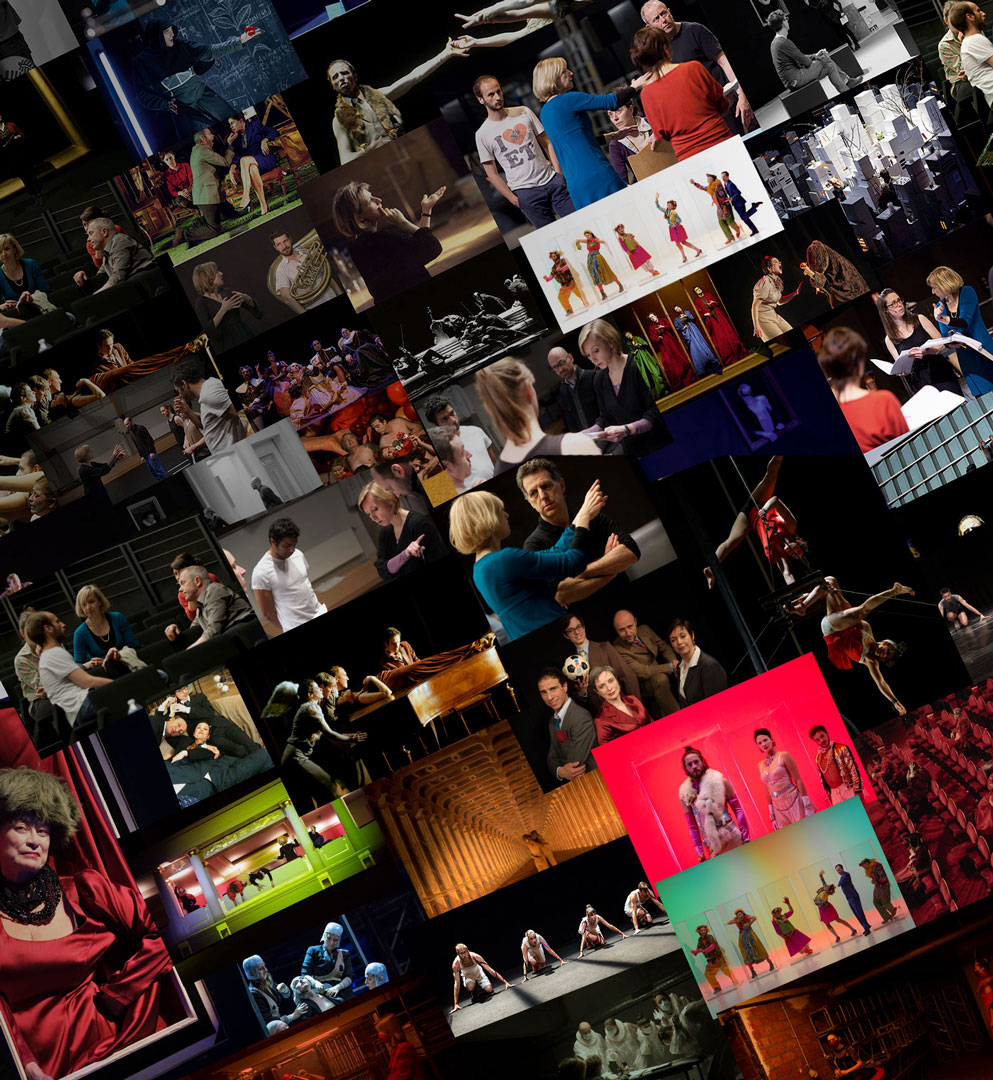
A Franco-German artist based in Brussels, Ingrid von Wantoch Rekowski creates resolutely atypical stage works: operas, musical theatre, performances, and tableaux vivants.
In 1994, she founded Lucilia Caesar, a creative laboratory that collaborates closely with artists from a wide range of disciplines to develop its productions. The company’s work explores the human condition in all its paradoxes and excesses, the tension between the sublime and the grotesque, the mythical and the trivial, ascent and fall. A place where genres and codes converge – always with a touch of humour – her productions offer a delightfully strange, deeply singular, and at times iconoclastic theatrical world, one that frequently seeks to give physical form to music.
Lucilia Caesar: while the name may evoke a slendid ancient queen, it actually refers to a golden fly (blowfly) – an insect with metallic sheen that accelerates the recycling of organic matter. This paradox defines the laboratory’s identity : beauty born from the trivial, a radiance emerging from decay. It is a space where the sacred meets the body, virtuosity embraces imperfection, and the sublime touches the fragility of life.

Thinking of the stage as a score
For Ingrid von Wantoch Rekowski, music – whether classical, pop or techno – is the driving force behind theatrical creation. It is its true architect. Every work is born from a score or takes shape as one, whether musical, pictorial, textual or physical. Body, space, time, sound and image intertwine to weave new associations and compose a sigular universe. At the heart of this mechanism the human being : fragile, funny and clumsy, driven by a desire for elevation yet constantly pulled back by the gravity of everyday life. The ordinary becomes extraordinary, the grotesque meets grace, and visual fantasy opens up spaces of wonder.
Bypassing linear narrative, her work favours a poetic and sensory experience that shifts our perspective and unsettles our certainties. Her theatre seeks that ‘jolt’ so dear to Roland Barthes: a moment when perceptions waver, rendering humanity and the world suddenly vaster, stranger, and profoundly more alive.


Journey: A work in motion
1994–2005 | The invention of a transdisciplinary language
With the founding of Lucilia Caesar, Ingrid von Wantoch Rekowski established a compositional style in which sound is embodied and the body becomes music. Seminal early works—including Luciano Berio’s A-Ronne II, Cena Furiosa (based on Monteverdi), Salvatore Sciarrino’s Lohengrin, In H-Moll (based on Bach), and Scarlatti’s La Vergine dei Dolori—laid the foundations for a space where the stage becomes pure composition.
2005–2018 | Polyphonies and Mythologies
Her research explores polyphonic forms in a state of metamorphosis. As an associate artist at the Théâtre National in Brussels, she created Lapsit exillis (based on Arthurian legend), Raphaël, les sirènes et le poulet (based on myth), and Le Tango des Centaures (based on Ovid, with Pascal Quignard and Kris Defoort). The journey continues with The Stereoscope of solitary Beings (J.R. Wilcock), Bug (a “body quartet”), and False Start (exploring the ordeal of the sprint). Literature, music, and imagery come together to create a theatre of constant transformation.
Since 2020 | Exploring new territories
Stage composition is venturing into new fields: opera intersects with cinema in Jean-Luc Fafchamps’ pop-requiem Is This the End? (premiered at La Monnaie / De Munt). Dancing Queens explores the intersection of disco and philosophy (with Pascale Seys); The revenge of the Tree by Patrick Leterme presents a symphonic and choral work; and Miserere is brought to life in collaboration with the Burkinabé choreographer Serge Aimé Coulibaly. The project continually broadens its horizons to create entirely new sensory experiences.
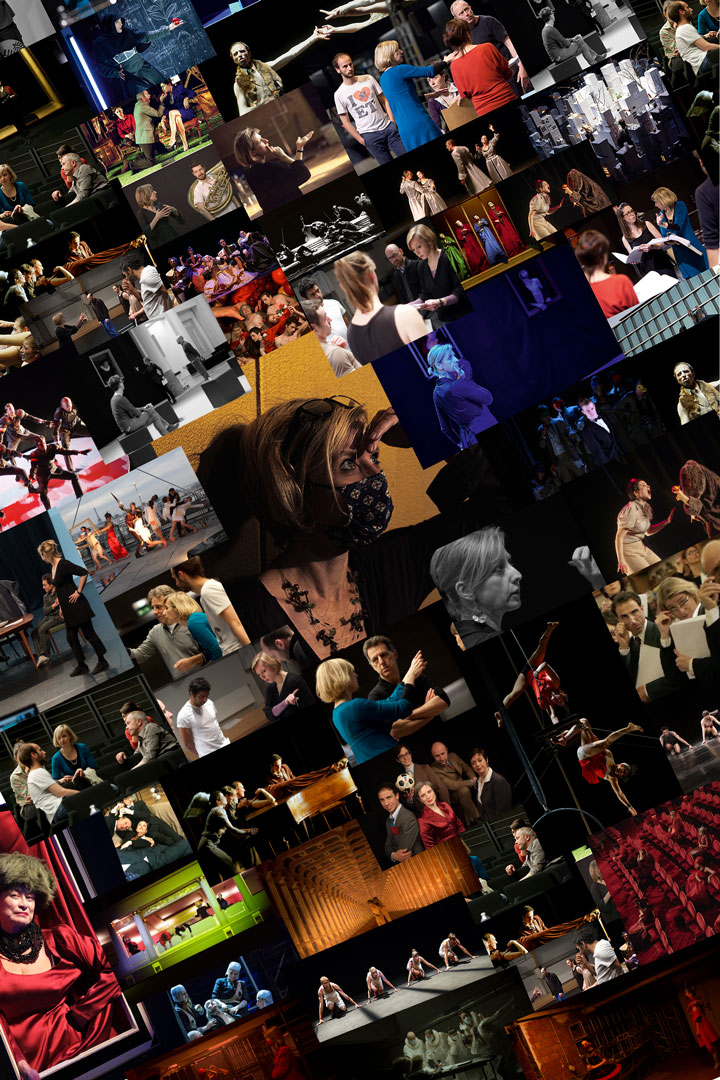
Influence & reach
An internationally renowned artist, her work has been featured on major stages:
- Belgium (La Monnaie / De Munt, BOZAR – Palais des Beaux-Arts, Flagey, Kunstenfestivaldesarts, Maison de Rubens / Rubenshuis)
- France (Centre Pompidou, Opéra Comique, Cité de la Musique & IRCAM, Théâtre des Bouffes du Nord, Festival d’Automne à Paris, Festival International d’Art Lyrique d’Aix-en-Provence, the opera houses of Lille, Bordeaux, Reims and Normandy-Rouen, the gardens of the Maison Veuve Clicquot in Reims, Théâtre National de Strasbourg)
- Germany (Hamburg State Opera, Stuttgart State Opera, HAU Berlin, Bavarian State Theatre, Munich)
- Austria (Mozarteum Salzburg, Vienna Festival, Salzburg Biennale)
- Switzerland (Zürcher TheaterSpektakel)
- Portugal (Culturgest, Lisbon)
- Italy (Opera San Carlo, Naples)
- Netherlands (Hermitage, Amsterdam)
- United Kingdom (Edinburgh International Festival)
- United States (L’Alliance, New York)
- Brazil (MUBE, São Paulo)
- Taiwan (National Kaohsiung Centre for the Arts, Kaohsiung)
A lecturer at INSAS since 2007 and a guest lecturer at various European art schools, she teaches an approach centered on musical grammar, physical engagement, and the invention of innovative theatrical languages.